![[LogoShip]](logo5.png)
Software for Windows
Science with your Sound Card!
Features:
Oscilloscope
Spectrum Analyzer
8-Channel
Signal Generator
(Absolutely FREE!)
Spectrogram
Pitch Tracker
Pitch-to-MIDI
DaqMusiq Generator
(Free Music... Forever!)
Engine Simulator
LCR Meter
Remote Operation
DC Measurements
True RMS Voltmeter
Sound Level Meter
Frequency Counter
Period
Event
Spectral Event
Temperature
Pressure
MHz Frequencies
Data Logger
Waveform Averager
Histogram
Post-Stimulus Time
Histogram (PSTH)
THD Meter
IMD Meter
Precision Phase Meter
Pulse Meter
Macro System
Multi-Trace Arrays
Trigger Controls
Auto-Calibration
Spectral Peak Track
Spectrum Limit Testing
Direct-to-Disk Recording
Accessibility
Data Logger
Waveform Averager
Histogram
Post-Stimulus Time
Histogram (PSTH)
THD Meter
IMD Meter
Precision Phase Meter
Pulse Meter
Macro System
Multi-Trace Arrays
Trigger Controls
Auto-Calibration
Spectral Peak Track
Spectrum Limit Testing
Direct-to-Disk Recording
Accessibility
Applications:
Frequency response
Distortion measurement
Speech and music
Microphone calibration
Loudspeaker test
Auditory phenomena
Musical instrument tuning
Animal sound
Evoked potentials
Rotating machinery
Automotive
Product test
Contact us about
your application!
Practical Spectrum Analyzer
As we have seen, our Conceptual Spectrum Analyzer has serious problems if the input signal is out of phase with the reference signal, even if the frequencies are the same.
But all is not lost. While we have relied upon the formula for the product of two sine waves, it turns out there is a very similar formula for the product of two cosine waves, which differs only in that the cos(A+B) term of the product is positive instead of negative. We can thus analyze the unknown signal via two pathways: One path multiplies the signal by a reference sine wave as before, while the other multiplies by a reference cosine wave of the same frequency. Each path performs a separate averaging and doubling operation, so we get two separate outputs which are the sine and cosine components of the input amplitude. We can find the true amplitude or "magnitude" at each reference frequency by taking the vector sum of the sine and cosine components.
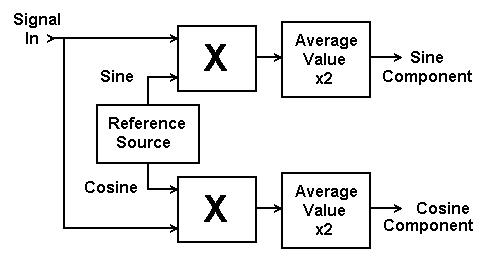
This is the essence of an ordinary "continuous" Fourier Transform, which according to standard formulations would entail using an infinite number of reference frequencies and averaging for an infinite time at each one to get infinite frequency resolution of our unknown input. If we are in a hurry, however, we might settle for somewhat less resolution by using fewer frequencies and shorter averaging times.
See also Spectrum (Fourier Transform) Theory

- Back to Conceptual Spectrum Analyzer
- Ahead to Spectrum Analysis Frequency Resolution
- Daqarta Help Contents
- Daqarta Help Index
- Daqarta Downloads
- Daqarta Home Page
- Purchase Daqarta
Questions? Comments? Contact us!
We respond to ALL inquiries, typically within 24 hrs.INTERSTELLAR RESEARCH:
Over 35 Years of Innovative Instrumentation
© Copyright 2007 - 2023 by Interstellar Research
All rights reserved