![[LogoShip]](logo5.png)
Software for Windows
Science with your Sound Card!
Features:
Oscilloscope
Spectrum Analyzer
8-Channel
Signal Generator
(Absolutely FREE!)
Spectrogram
Pitch Tracker
Pitch-to-MIDI
DaqMusiq Generator
(Free Music... Forever!)
Engine Simulator
LCR Meter
Remote Operation
DC Measurements
True RMS Voltmeter
Sound Level Meter
Frequency Counter
Period
Event
Spectral Event
Temperature
Pressure
MHz Frequencies
Data Logger
Waveform Averager
Histogram
Post-Stimulus Time
Histogram (PSTH)
THD Meter
IMD Meter
Precision Phase Meter
Pulse Meter
Macro System
Multi-Trace Arrays
Trigger Controls
Auto-Calibration
Spectral Peak Track
Spectrum Limit Testing
Direct-to-Disk Recording
Accessibility
Data Logger
Waveform Averager
Histogram
Post-Stimulus Time
Histogram (PSTH)
THD Meter
IMD Meter
Precision Phase Meter
Pulse Meter
Macro System
Multi-Trace Arrays
Trigger Controls
Auto-Calibration
Spectral Peak Track
Spectrum Limit Testing
Direct-to-Disk Recording
Accessibility
Applications:
Frequency response
Distortion measurement
Speech and music
Microphone calibration
Loudspeaker test
Auditory phenomena
Musical instrument tuning
Animal sound
Evoked potentials
Rotating machinery
Automotive
Product test
Contact us about
your application!
Sine Wave Basics
Consider the second hand on an "old-fashioned" round clock face: The hand makes an angle relative to a horizontal line drawn through the shaft from 9 to 3. The sine of that angle is proportional to the height of the tip of the hand above this reference line. (Heights are negative if the tip is below this.) Start with the hand at 9, and measure the height as it passes each numeral on the face:
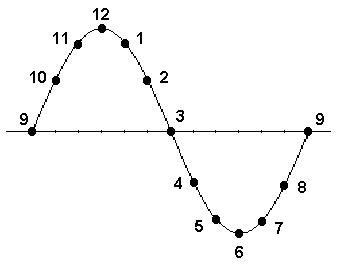
This is one cycle of a classic sine wave.
The amplitude of the clock sinusoidal wave is the length of the hand, which is the maximum height above or below the horizontal reference line.
The frequency of the wave is the number of cycles per unit time. On a clock, the second hand completes one cycle per minute. Although those who deal with rotating machinery use Cycles Per Minute (CPM), other users commonly refer to frequency in cycles per second, so we would say that the second hand completes 1/60 cycle per second. One cycle per second is called one hertz, abbreviated Hz and usually pronounced "hurts" (like the Hertz car rental agency), or "hairtz" in the native German of its namesake Heinrich Hertz.
We apply standard scientific prefixes to this, so 1000 hertz is 1 kilohertz (kHz) and 1/1000 Hz is 1 millihertz (mHz). Our second hand thus has a frequency of 1/60 Hz or 0.0166667 Hz or 16.6667 mHz. Note the small 'm' in 'mHz'. A large 'MHz' is used to refer to 1 million hertz or Megahertz. Small letters refer to prefixes less than one, capitals to those more than one. The exception to this is small 'k' for kilo... a tribute to the group wisdom of standards committees. Daqarta allows you to enter either 'K' or 'k', but always shows this as 'k'.
See also Sine Wave Phase, Magnitude via Vector Sum, Making Waves via Sine Wave Synthesis

- Back to Root Mean Square (RMS)
- Ahead to Sine Wave Phase
- Daqarta Help Contents
- Daqarta Help Index
- Daqarta Downloads
- Daqarta Home Page
- Purchase Daqarta
Questions? Comments? Contact us!
We respond to ALL inquiries, typically within 24 hrs.INTERSTELLAR RESEARCH:
Over 35 Years of Innovative Instrumentation
© Copyright 2007 - 2023 by Interstellar Research
All rights reserved