![[LogoShip]](logo5.png)
Software for Windows
Science with your Sound Card!
Features:
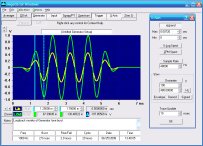
Oscilloscope
Spectrum Analyzer
8-Channel
Signal Generator
(Absolutely FREE!)
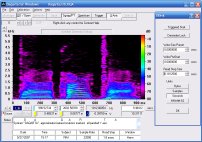
Spectrogram
Pitch Tracker
Pitch-to-MIDI
DaqMusiq Generator
(Free Music... Forever!)
Engine Simulator
LCR Meter
Remote Operation
DC Measurements
True RMS Voltmeter
Sound Level Meter
Frequency Counter
Period
Event
Spectral Event
Temperature
Pressure
MHz Frequencies
Data Logger
Waveform Averager
Histogram
Post-Stimulus Time
Histogram (PSTH)
THD Meter
IMD Meter
Precision Phase Meter
Pulse Meter
Macro System
Multi-Trace Arrays
Trigger Controls
Auto-Calibration
Spectral Peak Track
Spectrum Limit Testing
Direct-to-Disk Recording
Accessibility
Data Logger
Waveform Averager
Histogram
Post-Stimulus Time
Histogram (PSTH)
THD Meter
IMD Meter
Precision Phase Meter
Pulse Meter
Macro System
Multi-Trace Arrays
Trigger Controls
Auto-Calibration
Spectral Peak Track
Spectrum Limit Testing
Direct-to-Disk Recording
Accessibility
Applications:
Frequency response
Distortion measurement
Speech and music
Microphone calibration
Loudspeaker test
Auditory phenomena
Musical instrument tuning
Animal sound
Evoked potentials
Rotating machinery
Automotive
Product test
Contact us about
your application!
Sound Card Voltmeter
Controls: Options >> Voltmeter
Macros: VoltDlg, Volts
The Voltmeter dialog can be invoked from the Options Menu or toggled open or closed directly via ALT+V.
- Channel (L.In, R.In, L.Out, R.Out)
- RMS
- Peak-Peak
- Pos and Neg
- dB
- dB Ref
- Peak Hold
- Peak Reset
- Decimal Places
- Time Constant
Although it is possible to make measurements by means of the cursor readouts, the Voltmeter option simplifies and automates this process for best accuracy. It also offers an easily-set dB reference, plus a continuous Peak Hold display. (Peaks are continuously measured, and you can toggle between Peak and instantaneous at any time.)
Note: This easy-to-use Voltmeter option monitors a single selectable input or output channel. See the Multiple Meters Mini-App to simultaneously monitor up to two inputs and two outputs on individual meters, as well as providing additional measurement types like Crest Factor and frequency, plus options like plotting and data logging.
Alternatively, see the Custom Voltmeter subtopic under the Custom Frequency Counter Mini-App for a simple way to obtain custom features via a separate meter display, including separate calibration and offset, plus lowest, highest, and average values. You can easily add other custom calculations, and optionally enable data logging.
In order to measure voltage, your system must first be calibrated. Auto-Calibration allows Daqarta to keep track of relative sensitivity when you change Input levels, and Full-Scale Range calibration gives an absolute voltage sensitivity for each Input line.
Even though sound cards are AC-coupled, this voltmeter does respond to DC. This enables you to measure the DC value of positive or negative waveform portions with the Pos and Neg options, as well as the Peak-Peak difference between these.
Note: See DC Measurements And Outputs for ways to get true DC response. If you only need unipolar response from 0 to +5 volts, you can use the DaquinOscope macro mini-app that uses an inexpensive Arduino board for data acquisition.
You can also measure continuous DC or very low frequency signals by means of an external frequency-to-voltage circuit and the Fcal option of the Frequency Counter.
In general, there will be no overall DC level on sound card input or output signals due to the AC coupling, but the outputs are monitored by Daqarta in digital form, before the signal reaches the AC coupling point. So if you set a DC Offset value for a Generator stream, the Voltmeter will report it correctly. Although this DC value never makes it to the actual output, it can be useful for simulating real-world AC + DC situations. You might also want to measure a stream that you are setting up to be used as a Stream Modulator.
You can remove the DC portion of a measurement by means of the Data Zero option. (Note that Screen Zero has no effect on the Voltmeter.) The Data Zero Peak (Zero Pk) or Data Zero Average (Zero Av) modes effectively AC-couple the Voltmeter. Those modes are typically used to remove spurious offsets from the Mic preamp of inexpensive sound cards. Zero Manual allows you to remove specific DC levels, which you may want to do when using DC-responding sensors with a DC-coupled measurement system.
Besides measurements on live data, you can also apply the Voltmeter to file data, though true voltage readings will only be possible on .DQA files created on a calibrated Daqarta system. For other files, you will still be able to make relative readings to compare different portions of the same file, or different files created with the exact same system and mixer settings.
The Voltmeter dialog can be positioned by dragging its title bar in the usual Windows manner. The position and size will be maintained independently from other Daqarta dialogs, and will be saved across Daqarta sessions.
Unlike most Daqarta dialogs, the dialog size can be changed by dragging its borders. The numerical display font will be scaled proportional to the height of the dialog, allowing creation of extra-large displays for distant viewing. (On the initial use, you may need to adjust the size for your screen.)
Note: Larger characters take longer for Windows to draw on the screen. In Spectrogram or Pitch Track (Sgram/PT) modes with fast Trace Update rates and/or slow systems, this may be noticeable as slight gaps or discontinuities in the spectrogram or pitch track that repeat at 100 msec intervals (the meter update rate).
Note: To copy the Voltmeter displayed value to the Windows Clipboard, left-click anywhere in the central region of the meter display. This captures a copy of the current value and pops up a message box allowing you to save it to the Clipboard. CTRL+left-click saves it directly, without the message prompt. SHIFT+left-click includes the meter title above the meter value. CTRL+SHIFT+left-click includes the title and omits the prompt.
Note: The Voltmeter display update rate is approximately 10 times per second. A small asterisk is shown to the left of the RMS button on alternating meter updates. This assures you that the meter is in fact updating, even if the reading is unchanged due to a very stable signal.
Macro Notes:
VoltDlg=1 opens the Voltmeter dialog, VoltDlg=0 closes it, and VoltDlg=x toggles between open and closed.
VoltDlg#m=1 sets the dialog to minimized if open. VoltDlg#m=0 restores it, and VoltDlg#m=x toggles between minimized and restored.
You can read the current minimized state via X=VoltDlg?m, which will set variable X to 1 if the dialog is currently open and minimized, else 0.
Volts is a read-only variable that returns the mode-dependent current value displayed by the Voltmeter. It behaves as a numeric variable if assigned to a macro variable or used in a math expression, but when used in a string expression returns the same string that is shown in the Voltmeter readout. For example, if the Voltmeter display shows "5.018 mV" (with Decimal Places set to 3) then Msg=Volts will display that identical string. But A=Volts followed by Msg=A will show "0.005", or by Msg=A(0.6) will show "0.005018".

- Back to Sound Level Meter Decimal Places
- Ahead to Voltmeter Channel (L.In, R.In, L.Out, R.Out)
- Daqarta Help Contents
- Daqarta Help Index
- Daqarta Downloads
- Daqarta Home Page
- Purchase Daqarta
Questions? Comments? Contact us!
We respond to ALL inquiries, typically within 24 hrs.INTERSTELLAR RESEARCH:
Over 35 Years of Innovative Instrumentation
© Copyright 2007 - 2023 by Interstellar Research
All rights reserved