![[LogoShip]](logo5.png)
Software for Windows
Science with your Sound Card!
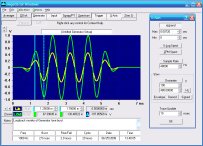
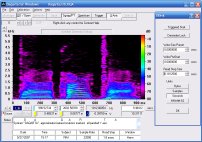
Sound Card Frequency Counter Screen Image
![[Daqarta Frequency Counter (16K image)]](FreqHz.png)
The Frequency Counter (like the Voltmeter and Sound Level Meter) can be positioned anywhere on the screen. The size of the display font changes when you resize the counter by dragging its borders. You can fill the screen for a really big readout that can be seen from across the room.
The counter has two different update rates: Fast (shown) is about 10 readings per second and Slow defaults to 1 per second, but can be set as high as 60 seconds for special cases. However, unlike conventional counters, high resolution can usually be obtained without long update intervals.
The Hertz mode shown has much higher resolution than conventional benchtop units. Those simply count the number of trigger events in the selected update interval.
Instead, Daqarta counts the total number of samples that elapse during the total number of triggers in the update interval. Since the sample rate is known and is very accurate, the signal frequency can be computed with similar accuracy after only a short time. This is analogous to setting Period mode on a conventional counter and counting the number of time-base cycles between input triggers, then computing the reciprocal. Here Daqarta takes care of all computations, and allows an aribtrary number of time-base cycles (samples) with an arbitrary number of input triggers between computations.
Daqarta also has access to more information about the signal than a benchtop counter, since it knows the amplitudes of the samples before and after the trigger event. This allows interpolation of the trigger time to give higher resolution than might be implied by the card's sample rate, compared to the clock of a conventional counter.
The Places control (near the right end of the counter window) allows selection of 0 to 9 decimal places for the reported Hertz value, currently shown set to 3. Separate settings are maintained for RPM and msec modes.
RPM mode is for use with engines and other rotating machinery. It uses the same techniques as Hertz mode to get high resolution at fast update rates, but it includes an automatic divide-by-60 conversion from hertz to revolutions per minute.
Consider that a conventional counter with a 1-second update rate can only show 1 Hz resolution. An engine running at 600 RPM would thus show only 10 Hz on such a counter, and you would have to manually multiply by 60 to convert to RPM... and get only 60 Hz resolution, and that at a slow 1-sec rate. Daqarta can show RPM directly, with resolution typically better than 0.001 RPM at 10 updates per second.
In addition, RPM mode uses the Cyl (Cylinders) control at the far right. This allows you to directly read RPM whether you are sensing pulses from a single cylinder or from the coil wire of a conventional ignition, for 4-stroke or 2-stroke engines of any number of cylinders. See Engine RPM Measurement under Automotive Applications in the Applications section for techniques.
The Cyl control also allows RPM measurement using gear-tooth sensors on any rotating machinery, with up to 1000 teeth per revolution.
The msec mode displays period directly, using the same measurement as Hertz mode but without a reciprocal.
Total mode counts trigger events since the last counter Reset. If the events of interest are bursts of tone or noise, you can use Trigger Holdoff to count only one event per burst instead of every cycle.
The Total count continues to accumulate even if you switch to Hertz or msec modes, and will read correctly when you switch back.
SpecTot is a special mode for counting events based upon spectral features, rather than normal triggering. It can distinguish between events that are similar in amplitude but different in spectral content, such as bird calls of different species, or different types of calls of the same species.
An event is counted only when the spectral content between the solid and dotted Spectrum cursors exceeds the absolute value of the Trigger Level.
In Delta cursor mode this requires at least one of the included spectral lines to exceed the Trigger Level; in Sigma mode the RMS value of the total included energy must exceed this threshold, even if no individual line does.
The Min and Max buttons allow you to monitor the lowest and/or highest Hertz, RPM, or msec readings since the last Reset. Min and Max values are continuously updated in the background for these modes, so you can view them at any time during operation or when Paused.
The Fcal button opens a dialog that allows you to apply a custom calibration to the display. This allows you to measure DC sensor values like temperature or pressure, by means of a voltage-to-frequency circuit. It also allows direct readout of MHz frequencies by means of a simple prescaler circuit.

Features:
Oscilloscope
Spectrum Analyzer
8-Channel
Signal Generator
(Absolutely FREE!)
Spectrogram
Pitch Tracker
Pitch-to-MIDI
DaqMusiq Generator
(Free Music... Forever!)
Engine Simulator
LCR Meter
Remote Operation
DC Measurements
True RMS Voltmeter
Sound Level Meter
Frequency Counter
Period
Event
Spectral Event
Temperature
Pressure
MHz Frequencies
Data Logger
Waveform Averager
Histogram
Post-Stimulus Time
Histogram (PSTH)
THD Meter
IMD Meter
Precision Phase Meter
Pulse Meter
Macro System
Multi-Trace Arrays
Trigger Controls
Auto-Calibration
Spectral Peak Track
Spectrum Limit Testing
Direct-to-Disk Recording
Accessibility
Data Logger
Waveform Averager
Histogram
Post-Stimulus Time
Histogram (PSTH)
THD Meter
IMD Meter
Precision Phase Meter
Pulse Meter
Macro System
Multi-Trace Arrays
Trigger Controls
Auto-Calibration
Spectral Peak Track
Spectrum Limit Testing
Direct-to-Disk Recording
Accessibility
Applications:
Frequency response
Distortion measurement
Speech and music
Microphone calibration
Loudspeaker test
Auditory phenomena
Musical instrument tuning
Animal sound
Evoked potentials
Rotating machinery
Automotive
Product test
Contact us about
your application!
Questions? Comments? Contact us!
We respond to ALL inquiries, typically within 24 hrs.INTERSTELLAR RESEARCH:
Over 35 Years of Innovative Instrumentation
© Copyright 2007 - 2023 by Interstellar Research
All rights reserved