![[LogoShip]](logo5.png)
Software for Windows
Science with your Sound Card!
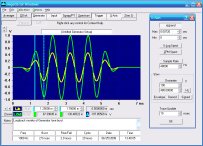
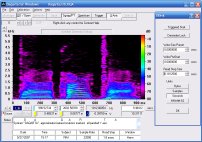
Features:
Oscilloscope
Spectrum Analyzer
8-Channel
Signal Generator
(Absolutely FREE!)
Spectrogram
Pitch Tracker
Pitch-to-MIDI
DaqMusiq Generator
(Free Music... Forever!)
Engine Simulator
LCR Meter
Remote Operation
DC Measurements
True RMS Voltmeter
Sound Level Meter
Frequency Counter
Period
Event
Spectral Event
Temperature
Pressure
MHz Frequencies
Data Logger
Waveform Averager
Histogram
Post-Stimulus Time
Histogram (PSTH)
THD Meter
IMD Meter
Precision Phase Meter
Pulse Meter
Macro System
Multi-Trace Arrays
Trigger Controls
Auto-Calibration
Spectral Peak Track
Spectrum Limit Testing
Direct-to-Disk Recording
Accessibility
Data Logger
Waveform Averager
Histogram
Post-Stimulus Time
Histogram (PSTH)
THD Meter
IMD Meter
Precision Phase Meter
Pulse Meter
Macro System
Multi-Trace Arrays
Trigger Controls
Auto-Calibration
Spectral Peak Track
Spectrum Limit Testing
Direct-to-Disk Recording
Accessibility
Applications:
Frequency response
Distortion measurement
Speech and music
Microphone calibration
Loudspeaker test
Auditory phenomena
Musical instrument tuning
Animal sound
Evoked potentials
Rotating machinery
Automotive
Product test
Contact us about
your application!
Sound Card Duplex, Half and Full
This term arises from communications use, where full-duplex (sometimes spelled without the hyphen) refers to a system that can send and receive simultaneously, as in a standard telephone (where only politeness prevents both parties from talking at the same time). Half-duplex systems can only do one thing at a time, either send or receive.
The "full-duplex" designation is often applied to sound cards that can acquire input data via an ADC at the same time they are producing output data via a DAC. Note that "full" tells nothing about the bit resolution in each direction, and a sound card may legitimately be called "full-duplex" if it can acquire 16-bit data while generating 8-bit data, or vice-versa. (This was the case with most ISA-bus Sound Blaster cards, for example.)
"Full" also tells nothing about the number of channels in each direction. Most full-duplex cards can achieve stereo operation in both directions, but there are some cards that are stereo in either direction alone but only mono in both directions at once.
Your sound must have full-duplex capabilities in order to produce stimulus outputs with the Daqarta Generator during Input data acquistion.
However, even stereo full-duplex cards may not synchronize the input and output streams properly, or maybe only at certain sample rates. It is thus important to use the Duplex Delay option during Auto-Calibrate to determine the card's capabilities.
See also Full-Duplex Techniques

- Back to Sound Card DC Pulse Output Circuits
- Ahead to Expnote.DAT Arb File
- Daqarta Help Contents
- Daqarta Help Index
- Daqarta Downloads
- Daqarta Home Page
- Purchase Daqarta
Questions? Comments? Contact us!
We respond to ALL inquiries, typically within 24 hrs.INTERSTELLAR RESEARCH:
Over 35 Years of Innovative Instrumentation
© Copyright 2007 - 2023 by Interstellar Research
All rights reserved