![[LogoShip]](logo5.png)
Software for Windows
Science with your Sound Card!
Features:
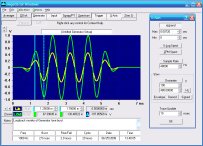
Oscilloscope
Spectrum Analyzer
8-Channel
Signal Generator
(Absolutely FREE!)
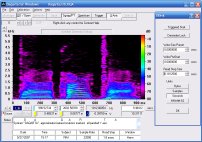
Spectrogram
Pitch Tracker
Pitch-to-MIDI
DaqMusiq Generator
(Free Music... Forever!)
Engine Simulator
LCR Meter
Remote Operation
DC Measurements
True RMS Voltmeter
Sound Level Meter
Frequency Counter
Period
Event
Spectral Event
Temperature
Pressure
MHz Frequencies
Data Logger
Waveform Averager
Histogram
Post-Stimulus Time
Histogram (PSTH)
THD Meter
IMD Meter
Precision Phase Meter
Pulse Meter
Macro System
Multi-Trace Arrays
Trigger Controls
Auto-Calibration
Spectral Peak Track
Spectrum Limit Testing
Direct-to-Disk Recording
Accessibility
Data Logger
Waveform Averager
Histogram
Post-Stimulus Time
Histogram (PSTH)
THD Meter
IMD Meter
Precision Phase Meter
Pulse Meter
Macro System
Multi-Trace Arrays
Trigger Controls
Auto-Calibration
Spectral Peak Track
Spectrum Limit Testing
Direct-to-Disk Recording
Accessibility
Applications:
Frequency response
Distortion measurement
Speech and music
Microphone calibration
Loudspeaker test
Auditory phenomena
Musical instrument tuning
Animal sound
Evoked potentials
Rotating machinery
Automotive
Product test
Contact us about
your application!
Distorted Sound Output
In order to simplify diagnosis, it is best to use the default Generator setup of a simple 440 Hz sine wave. If you have changed your setup, please go to Restore Default Generator Setup before you proceed here.
The most common form of distortion is clipping, which is where the sound system is overdriven; it is trying to produce a sound that is louder than its capabilities. The tops and bottoms of the waveform will be chopped off or "clipped" at the maximum and minimum voltages the system can produce. If this happens to a pure sine wave, it starts to sound "buzzy", more like a square wave. (When driven hard enough, a sine wave can look very much like a square wave.)
The first thing to check is that you are not asking Daqarta to create a waveform that exceeds the digital limits of the 16-bit number system. If the distortion goes away when you use the default Generator setup at the same volume settings, the problem setup most likely had more than one Stream active on the same channel, with the total Level adding up to more than 100%.
If you still hear a buzzy sound, the next thing to investigate is whether the mixer is overdriving the sound card amplifier, or, if you are using an external amplifier, if the sound card is overdriving that. You might even be overdriving the speakers or headphones, which have mechanical limits similar to the electrical limits of amplifiers. Use the Daqarta volume (Vol) sliders to reduce both Master and Wave levels to see if this reduces the buzz. Many cards distort if one or both of these controls are at maximum.
Another possibility is that you are driving headphones or unpowered speakers from a Line output that has limited power. If this is the case, you can still usually reduce the volume to a point where it is undistorted, but it may be too soft to be useful. Look for a Spkr output instead, or try using an external amplifier.
Finally, check the Distorted Input/Output Waveform or Spectrum topic, below. If that doesn't eliminate the distortion, you may have a defective sound card, external amplifier, speaker, or headphones.
See also Troubleshooting, Stuttering Sound Output

- Back to No Sound Output
- Ahead to Distorted Input/Output Waveform or Spectrum
- Daqarta Help Contents
- Daqarta Help Index
- Daqarta Downloads
- Daqarta Home Page
- Purchase Daqarta
Questions? Comments? Contact us!
We respond to ALL inquiries, typically within 24 hrs.INTERSTELLAR RESEARCH:
Over 35 Years of Innovative Instrumentation
© Copyright 2007 - 2023 by Interstellar Research
All rights reserved